

BILBAO RÍA 2000 LAUNCHES THE TENDERING OF THE RAILWAY INTEGRATION PROJECT SIMULTANEOUSLY WITH THE INTERNATIONAL CONTEST TO DESIGN THE NEW OLABEAGA NEIGHBOURHOOD
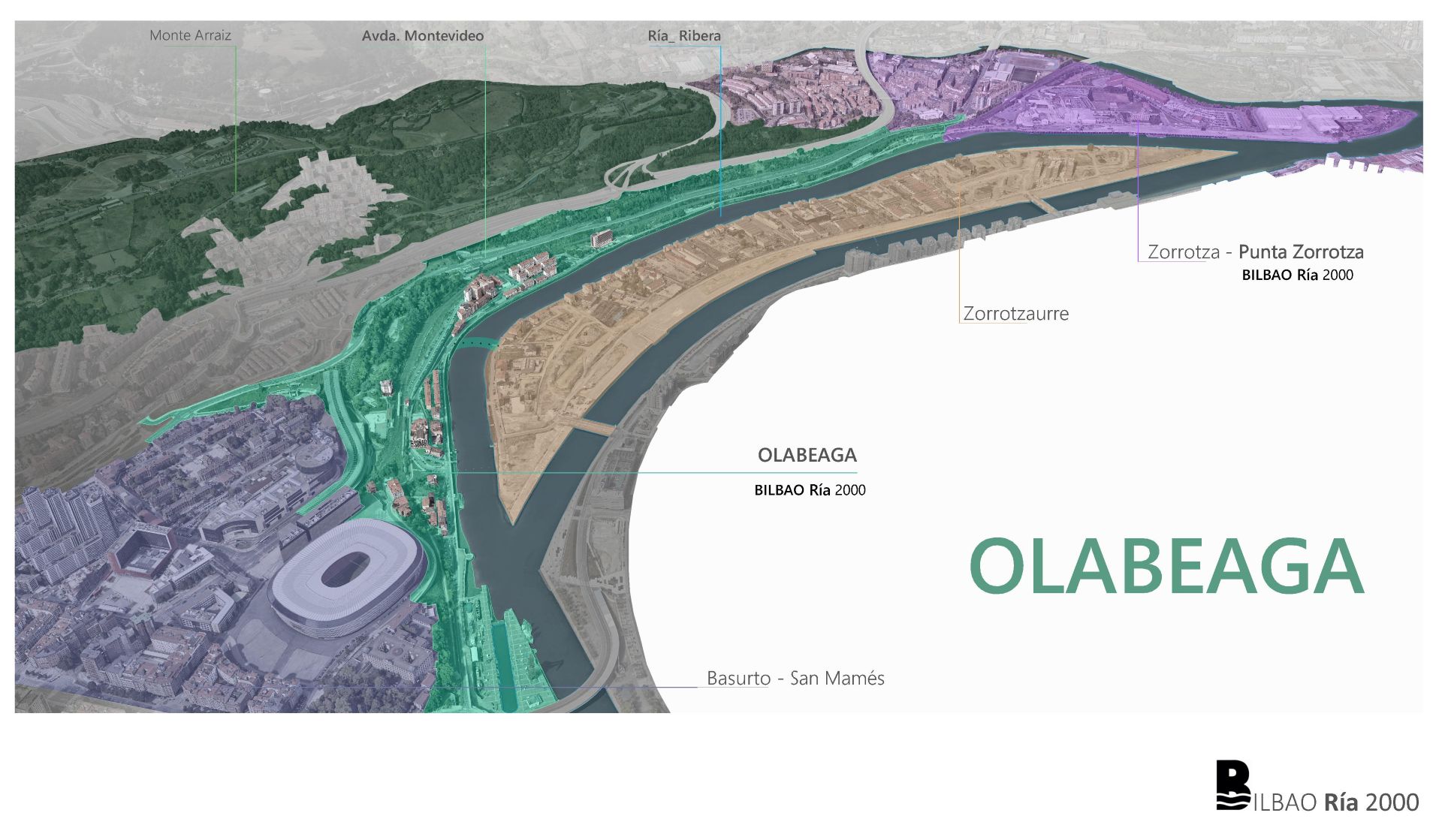
- The company has put out to tender the basic and construction projects to move the train towards the Montevideo Avenue embankment on its route through this neighbourhood of Bilbao; that will free up an area of opportunity for the contest to establish how the solution will be incorporated into the city.
- The railway integration project will consider the laying out of 1,270 metres of the C1, C2 and freight lines, the cover structure, the new passenger station, the electricity sub-station and the dismantling of the sections of disused track.
- The tender amount is EUR 2.3 million and BILBAO Ría 2000 and Adif will be the co-directors of the project implementation.
- In turn, the international design project with jury intervention will provide a broad outline of the urban development, improve the existing Olabeaga neighbourhood, and will enable a balanced development of Olabeaga and the city in the metropolitan continuum; it will be connected to Punta Zorrotza, which BILBAO Ría 2000 will also manage.
- The winning team selected by the jury will draft the Master Plan and the Urban Development Preliminary Project with a budget of EUR 425,000.
- Both the railway integration and the urban development processes will be rolled out simultaneously, will be coordinated and coherent from a functional and construction perspective.
- In October, the Spanish Ministry of Transport and Sustainable Mobility, Adif, Bilbao City Council and BILBAO Ría 2000 – the signatories of the Olabeaga development institutional agreement – determined to set in motion both processes, in tandem to the processing of the informative study to establish the train layout.
Bilbao, 27th February 2026.- The OIabeaga roadmap continues to move forward with new milestones. BILBAO Ría 2000 has convened the procurement of the drafting of the basic and construction projects to integrate the train route through the neighbourhood, together with the international project with jury intervention for the urban development of the surrounding area.
The railway integration will move the train towards the Montevideo Avenue embankment as it runs through this neighbourhood of Bilbao; that will free up an area of opportunity for the contest to establish how the solution will be incorporated into the city. The project will include the laying out of 1,270 metres of the C1, C2 and freight lines that run through the neighbourhood, the cover structure, the new passenger station, the electricity sub-station and the dismantling of the sections of disused track. Subsequently, and once the Spanish Ministry of Transport has definitively approved the informative study to modify railway line, the Master Plan will be submitted for the formalities required for the special plan envisaged in the PGOU (general land-use plan) to develop the area.
Simultaneously, the international contest is looking for the best team to – under the oversight of BILBAO Ría 2000 – establish the broad outline of the urban development for the whole area, improve the existing Olabeaga and enable the balanced development of Olabeaga and the city in the metropolitan continuum; it will be connected to Punta Zorrotza, which BILBAO Ría 2000 will also manage. BILBAO Ría 2000 has therefore launched the following Design Contest with jury intervention for the urban development of the Olabeaga area, given the special multidisciplinary technical complexity, the strategic importance of the area to be managed and developed, and the need to have the best representation of the professional sectors involved for its definition.
In October, the Spanish Ministry of Transport and Sustainable Mobility, Adif, Bilbao City Council and BILBAO Ría 2000 – the signatories of the Olabeaga development institutional agreement – determined to set in motion both processes, in tandem to the processing of the informative study to establish the train layout. This marked the start to improve and transform the Olabeaga neighbourhood, a complex project on which BILBAO Ría 2000 will be working for the coming ten years.
Railway integration project
BILBAO Ría 2000 has put out to tender the drafting of the project to integrate the railway on its route through Olabeaga. The C1 and C2 commuter trains currently run along there, along with freight trains from the Port of Bilbao. The railway integration projects will develop the proposal set out in the informative study currently under consideration by the Spanish Ministry of Transport and Sustainable Mobility.
The project will be coordinated and fully compatible with other planned actions in the area, such as the Southern Freight Railway Bypass, extending the Bilbao tramway to Zorrotzaurre, and the urban development itself.
The need to keep the existing station with the current levels of service remaining in operation will be taken into account when drafting the project; that will require the project to define the necessary provisional measures to ensure the rail service is not disrupted.
The scope of the construction project will include defining the layout of the railway bypass, the cover structure, the new station, the electricity substation and the dismantling of the disused sections of track; the commuter and freight services will continue to run throughout. Thus, the infrastructure (civil works and structures), track bed, tracks, electrifications, safety facilities, passenger station and, in general, all the civil works needed for the actions envisaged in the basic project, will be planned. The transfer or replacement of all the elements and services affected by the implementation of the works will also be included.
Similarly, BILBAO Ría 2000 and Adif will also co-direct the railway integration work put out to tender. The contest has been convened with an initial tender budget of EUR 2.3 million and the drafting period will be 24 months.
Characteristics of the International Urban Development Contest
BILBAO Ría 2000 has also launched a design contest with jury intervention for the urban development of Olabeaga and will define the urban development guidelines; BILBAO Ría 2000 plans to undertake it based on knowledge and respect of the current reality of Olabeaga, and in balance with the rest of the city and the metropolitan continuum of which it is part.
The aim is to achieve the best quality urban space, which includes the necessary development of housing and amenities, and always taking into consideration the constraints, boundaries and existing or future needs. For example, the relationship with the estuary, the orography of Mount Arraiz, the necessary roads, pedestrian access, accessibility, the development of amenities and housing, the connection with the city centre, the continuity with Punta Zorrotza and Abandoibarra through the Euskalduna docks and the improvement of the relationship with the surroundings of San Mamés – Basurto must be a priority to ensure territorial cohesion.
Moreover, this new development must form part of the economic space of the city, promote employment, entrepreneurship and competitiveness, by generating economic traction from the tertiary, commercial and equipment spaces that arise, and also complementing and increasing the offer of services in the neighbourhood itself.
Contest goals
The priority goals to be met by the development entries in the contest are:
- Inclusiveness and enhancement of today’s Olabeaga.
The contest must be based on knowledge and respect of the current reality of Olabeaga and the entries must include aspects that clearly contribute to its improvement.
- The symbiosis between urban development and the railway solution.
The railway integration is essential for the subsequent urban development of the neighbourhood; both processes must be coordinated and rolled out simultaneously. It is therefore particularly important that BILBAO Ría 2000 leads and implements both processes and projects.
- A new balanced space in the metropolitan continuum.
Olabeaga is a neighbourhood that must retain its essence and its identity, while also being called on to play an important role in the city. Its development can therefore not be undertaken as a stand-alone approach; it will need to take into account continuity and the relationship with Basurto, Zorrotzaurre and Punta Zorroza, and what it can contribute to the rest of the city.
- Proximity services integrated into the existing fabric.
It is an opportunity for the present and future neighbourhood to increase the proximity services.
- Generating value in the urban design of the city.
The urban planning quality and the relationship of the new development with the existing reality will be taken into account.
- The economic, technical, social and environmental feasibility of the project.
Urban development that allows the railway to be integrated is key to the financing both of the integration itself and of the new neighbourhood, coupled with the significant institutional investment, set out in the agreement between the Spanish Ministry of Transport and Sustainable Mobility, Adif, Bilbao City Council and BILBAO Ría 2000 for the railway and urban development to be integrated.
Scope of the contest
Two levels are defined within the scope of the contest, in order to work appropriately on the different scales of the neighbourhood – the current and the future Olabeaga –, the immediate environment, the city and the metropolitan continuum. Level 1 has an area of approximately 25 hectares, and is included in the purpose of both the Master Plan and the urban development preliminary plan.
In turn, the boundaries of Level 2 are Montevideo Avenue to where it reaches Zorrotza; the vicinity of the San Mames stadium; the Euskalduna levees and surrounding areas; the Olabeaga promenade; and the sheet of water. Level 2 has a surface area of around 57 hectares and is included in the purpose of the Master Plan.
Contest phases
The first phase of the contest is open and on the basis of free competition, with no economic consideration. A maximum of six entries will be selected for the second phase from among all those submitted, based on their capacity, solvency and previous works; each team will receive an economic consideration of EUR 46,000 to submit its proposal. Furthermore, the winning team will also be awarded the drafting of the Olabeaga Master Plan for an amount of EUR 225,000 and an implementation period of twelve months; and the drafting of the Urban Development Preliminary Project of the area for an amount of EUR 200,000, under the direction of BILBAO Ría 2000, with a ten-month preparation period, which can overlap with the drafting period of the Master Plan.
In addition, the contest winner will receive a further EUR 10,000 as the prize for the contest. Furthermore, the Jury may propose up to two runner-up prizes that will be endowed, where appropriate, with EUR 6,000 and 4,000, respectively.
The winning team
The Jury is made up of representatives of BILBAO Ría 2000, ADIF, Bilbao City Council, the Basque-Navarre Institute of Architects (COAVN), from among the members of the Basque-Navarre Association of Urban Planning Architects (AVNAU), the Basque Country Chapter of the Professional Association of Civil Engineers, and an urban planner of recognised standing. Its mission will be to select the best entry in order to have the best team with which to jointly work on the Master Plan,
The minimum technical team must consist of at least seven people, with the following professional profiles:
- 1 person in charge of the team, qualified to produce urban development projects and urban planning instruments, who will be the author of the Master Plan and the Urban Development Preliminary Project.
- 1 specialist in territorial planning and urban design.
- 1 specialist in urban landscaping and gardening
- 1 specialist in infrastructures, road network, urban mobility and facilities.
- 1 specialist in efficient and sustainable management of energy, water and material resources as well as waste.
- 1 specialist in sustainable and healthy urban planning.
- 1 specialist in urban sociology and interaction in public space.
Following steps
Once the basic and construction projects for the railway integration in Olabeaga have been drafted, BILBAO Ría 2000 will be able to put out to tender the works, which could begin in 2029.
In turn, the winning team of the International Contest will be known in 2026; it will have to draft the Master Plan and the Urban Development Preliminary Project, whose work time will run simultaneously with the railway design. After the urban planning formalities have been completed, the urban development work could begin in 2029-2030, in coordination with the railway integration.
The culmination of both processes will result in new coexistence spaces in Olabeaga and the city, thanks to significant institutional investment, the outcome of the consensus and unanimity for which BILBAO Ría 2000 is known.
About BILBAO Ría 2000
BILBAO Ría 2000 is a consensus space for the economic and social development of the territory in metropolitan Bilbao.
The presence of all the public administrations on its Board of Directors allows its members to drive complex projects – beyond their routine remits – throughout all the phases involved: vision, planning, designing and implementation.
The starting point and destination of the BILBAO Ría 2000 action plans are in the same place: the people, their neighbourhood, the city and the territory. The projects improve their quality of life and wellbeing, drive economic activity and connect milieus with their current and future inhabitants, based on criteria of inclusion, sustainability and respecting diversity. Since it was set up in 1992, the company has invested over EUR 1 billion for the social and economic development of the territory.
Such complex territory projects require consensus, vision, capacity and experience, the main values of BILBAO Ría 2000.